Does Reincarnation Exist?
Exploring One of Humanity’s Most Enduring Questions
For thousands of years, human beings have asked the same profound question: What happens after we die? Across cultures, religions, and philosophical traditions, one idea has appeared again and again: reincarnation — the belief that consciousness or some aspect of our identity continues after death and is reborn into another life.
For some people, reincarnation offers comfort and meaning. For others, it raises difficult questions about memory, identity, and evidence. Today, the idea exists at the intersection of spirituality, philosophy, psychology, and even scientific curiosity.
But does reincarnation really exist?
The answer depends largely on how we define existence, consciousness, and what kinds of evidence we accept.
What Is Reincarnation?
Reincarnation is the concept that after physical death, an aspect of a person — often described as the soul, consciousness, or essential self — returns in a new body or form of existence.
This belief appears in many traditions:
- Hinduism teaches that the soul (Atman) experiences multiple lifetimes as part of a journey toward liberation.
- Buddhism speaks of rebirth, though with a different understanding of identity and continuity.
- Certain schools of ancient Greek philosophy explored the migration of souls.
- Various indigenous and mystical traditions around the world include concepts of cyclical existence.
Although interpretations differ, a common idea remains: life may not be a single isolated event, but part of a larger process.
Why Has the Idea Persisted Across Civilizations?
One reason reincarnation has endured is that it attempts to answer universal human experiences.
People often wonder:
- Why do some individuals seem naturally drawn to certain places, cultures, or abilities?
- Why do some children display unusual talents at an early age?
- Why do certain fears or emotional patterns appear without an obvious cause?
- Is life completely random, or is there a deeper continuity behind human experience?
Reincarnation offers one possible framework for understanding these questions.
However, the persistence of an idea does not necessarily prove it to be true. Many beliefs survive because they address emotional, philosophical, or existential needs.
Spiritual Perspectives: A Journey of Growth
From a spiritual point of view, reincarnation is often understood as a process of learning and evolution.
According to this perspective, each lifetime provides opportunities to develop qualities such as compassion, understanding, courage, and self-awareness.
Challenges, relationships, and major life events may be viewed not as random occurrences but as experiences that contribute to personal growth.
Some people who believe in reincarnation describe feeling:
- A sense of familiarity with unknown places
- Strong emotional connections upon meeting certain individuals
- Repeating life themes or patterns
- A deep intuition that life extends beyond physical existence
These experiences are meaningful to those who live them, though they remain subjective and difficult to verify scientifically.
What Does Science Say?
From a mainstream scientific perspective, there is currently no conclusive evidence proving reincarnation.
Modern neuroscience generally understands consciousness as closely connected to brain activity. Under this model, memories, identity, and awareness emerge from physical processes.
When the brain stops functioning, conventional science does not currently recognize a mechanism through which personal consciousness survives and transfers into another body.
At the same time, consciousness itself remains an area of ongoing exploration.
Questions such as:
- What creates subjective experience?
- Why are we conscious at all?
- Is consciousness entirely produced by the brain?
remain active areas of philosophical and scientific discussion.
Some researchers have examined reports that appear difficult to explain through ordinary memory or suggestion alone, but these cases remain controversial and are not considered proof of reincarnation.
Children Who Recall Previous Lives
One of the most frequently discussed areas related to reincarnation involves reports of young children who describe memories that seem to belong to another life.
These accounts sometimes include:
- Specific names
- Descriptions of places
- Emotional reactions
- Recognition of unfamiliar people or environments
Supporters argue that some cases contain details that appear unusually precise.
Skeptics point out alternative explanations, including:
- Coincidence
- Suggestion from family or environment
- Memory construction
- Selective interpretation
Because these experiences are difficult to reproduce under controlled conditions, they remain open to interpretation.
Psychological Interpretations
Not everyone who explores past-life experiences believes they represent literal reincarnation.
Psychology offers other possible explanations.
Experiences interpreted as past-life memories may sometimes reflect:
- Symbolic narratives created by the unconscious mind
- Emotional processing
- Archetypal imagery
- Deep imagination states
- Hidden personal associations
From this perspective, whether a memory is historically true may matter less than what it reveals emotionally.
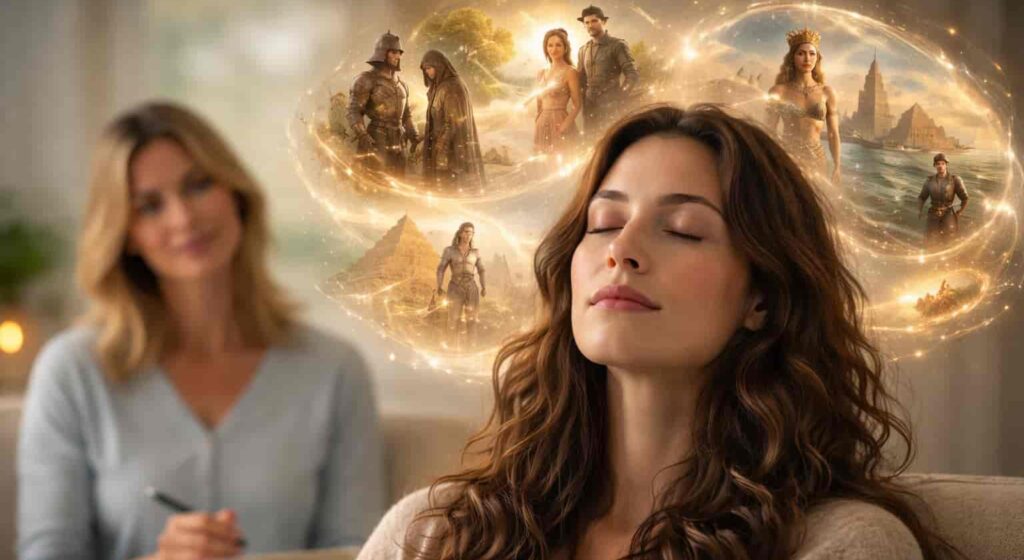
For example, someone who experiences a vivid scene during meditation or therapeutic work may gain insight into fears, relationships, or recurring patterns in their current life.
The value, in this view, lies in self-understanding rather than historical verification.
Can Reincarnation Be Proven?
This depends on what we mean by proof.
Scientific proof generally requires observable, measurable, and repeatable evidence.
Spiritual experiences are often personal, internal, and difficult to reproduce.
Because reincarnation sits between these two worlds, it remains a topic where certainty is elusive.
For some people, the absence of proof means there is no reason to believe.
For others, the absence of proof does not eliminate the possibility.
Many people ultimately arrive at their own conclusions based on a combination of reflection, personal experiences, spiritual beliefs, and philosophical inquiry.
A Question That Invites Exploration
Perhaps one reason reincarnation continues to fascinate humanity is that it touches something deeper than curiosity.
It asks:
- Are we more than our physical bodies?
- Does consciousness have limits?
- Is identity fixed or evolving?
- Could life be part of a larger journey?
These questions do not have universally accepted answers.
Whether reincarnation is understood as a literal continuation of life, a symbolic language of the psyche, or a spiritual mystery, its enduring presence suggests that humans continue to seek meaning beyond what can be immediately seen.
Final Thoughts
So, does reincarnation exist?
At present, there is no scientific consensus confirming it as an objective reality. Yet across cultures and generations, countless people continue to explore the possibility that consciousness extends beyond a single lifetime.
For some, reincarnation is a spiritual truth.
For others, it is a metaphor for growth and transformation.
And for many, it remains one of life’s most intriguing unanswered questions — inviting not certainty, but curiosity.